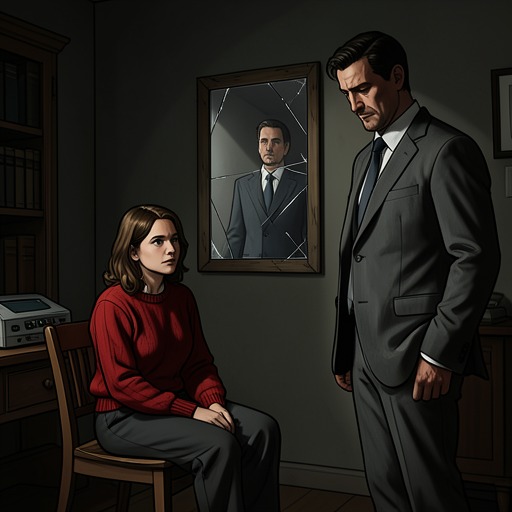
Hidden basement of the Delta Brotherhood Mansion
Of Fates & Fables (The Complete Series)The hidden basement of the Delta fraternity house is a concealed room behind a false wall, and one of the most important physical traces of Brody Harrison’s criminal werewolf network. What appears to be a fraternity residence contains a sealed interior space where unwilling men were held during transformation and where Brody’s wider system of coercion began. The room converts an ordinary campus building into a site of captivity, concealment, and organized violence.
Location and Concealment
The room is part of the Delta house, where Brody Harrison operated his activities while presenting the fraternity setting as ordinary student life. Missy Quinn identifies it as a basement room hidden behind a false wall and explains that Brody used to run everything from there. Its architecture depends on concealment rather than distance: the danger is embedded inside a familiar social institution, protected by a barrier that can be closed and disguised when outsiders approach.
The room’s camouflage is reinforced by the fraternity’s social network. After Missy fled and reported what she had seen, Brody Harrison closed the room and concealed its entrance behind wall art. The campus police failed to locate either the room or the people inside it, while Brody’s fraternity brothers covered for him. Their protection worked partly because the authorities were unlikely to believe that werewolves existed, allowing the physical evidence to remain hidden in plain sight.
The Discovery and Its Contents
Missy Quinn discovered the room while looking for storage space at Delta. She had intended to leave personal boxes there, along with jars of moonshine sent by her brother, when she found the secret-room door open. Inside the tiny room were four men in various stages of transformation. One of them moved toward her, and she escaped by running to campus police without stopping.
The scene gives the room a distinct horror: it is not merely a hidden chamber but a cramped holding space in which human bodies are being forcibly remade. The partially transformed men expose the physical process that Brody Harrison’s public persona conceals. Missy’s flight also establishes the room as the point at which her relationship with Brody Harrison changes from troubling intimacy to direct recognition of an intolerable system.
Although the police found no room and no captive men, Missy understands that its emptiness does not mean the operation has ended. She concludes that Brody Harrison probably moved the transformed men to the place where he was keeping the captive girls. The abandoned chamber therefore functions as evidence of a continuing network rather than as an isolated crime scene: its cleared interior points toward a larger, undiscovered site of confinement.
Relation to Brody Harrison’s Abuse
The hidden basement is closely tied to the coercive relationship between Brody Harrison and Missy Quinn. They began dating during their senior year, before Missy knew what Brody was. Once they reached college, his insults became threats, particularly after Missy refused to let him transform her. The room supplies the material context for that escalation. Brody’s desire to possess the power of a werewolf is not presented as a private identity but as a resource he uses to dominate partners, recruit others, and punish resistance.
Missy’s discovery also reveals that Brody Harrison’s recruitment was not voluntary across the board. He had initially recruited some people, but when additional recruits were unwilling, Missy drew the line. The four men in the room thus stand as early evidence that Brody’s pack-building depends on force. The same logic later expands into the abduction, forced transformation, pregnancy, and marking of women held elsewhere, making the basement an early local version of the larger breeding program.
The room’s false wall mirrors Brody Harrison’s method of control. He isolates victims, hides their bodies from public scrutiny, uses intimidation to prevent disclosure, and relies on institutions that dismiss their testimony. The space is therefore both a physical enclosure and a social mechanism: the wall hides the captives, while disbelief and fraternity loyalty protect the person who put them there.
Narrative Function and Consequences
For Romy Cartelli, the room is not an abstract rumor. She has seen it, and the memory of the moonshine stored there is connected with the moment before she was knocked unconscious and kidnapped. That detail links Missy Quinn’s earlier escape to Romy Cartelli’s later captivity, showing that the Delta house is part of a continuous chain of violence rather than merely Brody Harrison’s former hideout.
The rescue of the pregnant captive women confirms the scale toward which the basement’s secret has grown. The rescued women bear tattoos matching Brody Harrison’s and emerge frightened, wide-eyed, and visibly pregnant. Their condition gives concrete human consequences to the transformations and breeding practices foreshadowed by the four men in the hidden room. Kaitlyn’s insistence that her child, Hunter, was never the result of her choice further rejects any attempt to recast Brody Harrison’s program as romance, reproduction, or pack-building without violence.
By exposing what can be hidden behind a fraternity wall, the room changes the conflict from a matter of individual danger into a collective struggle against Brody Harrison’s bid for power. The secret basement is the architectural proof that his ambitions are organized, protected, and territorial. Its discovery helps Romy Cartelli and her allies understand that they are not simply responding to one abduction or one abusive relationship; they are confronting a system that turns homes, fraternities, bodies, and silence into instruments of control.